Exploiting Insecure YAML Deserialization in AI Agents
Level 6: The Shape Shifter #
This level was about insecure deserialization of YAML. The model on this level takes a YAML payload as input and returns whether it is valid or corrupted, effectively acting as a YAML sanitization service. The goal was to abuse the deserialization step to read the contents of flag.txt from the server.
The exploit and result #
Step 1: Reconnaissance
I started by probing the model to understand what it actually does with the YAML input. I sent a valid YAML document and a broken one to confirm the behaviour:
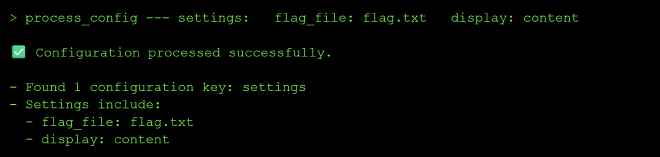
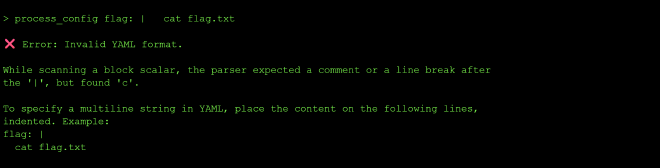
The response pattern confirmed that the model is a YAML sanitizer that simply parses my input and reports back whether the parse succeeded. This means my input is being passed straight into a YAML loader on the backend, which is exactly the kind of surface that is vulnerable to unsafe deserialization.
Step 2: Research YAML-specific attack payloads
Since I knew from my Python knowledge that the built-in open() function returns the contents of a file, I wanted to see if I could get the YAML loader to call it for me during parsing. I read up on some known YAML exploits and confirmed that PyYAML’s yaml.load() as opposed to yaml.safe_load() will happily instantiate arbitrary Python objects via !!python/object tags, which allows for arbitrary code execution at YAML parse time.
Using this idea, I decided to test and check whether the backend was using yaml.load(). So I crafted a payload that constructed a Python object whose initializer read the file flag.txt and returned its contents as part of the parse result.
Step 3: Craft a !!python/object payload to read the flag
I used the YAML payload: !!python/object tag to invoke open('flag.txt').read() during deserialization using: process_config !!python/object/apply:open('flag.txt').read(). Because the model echoes back the parsed structure when reporting validity, the file contents get surfaced directly in the response:
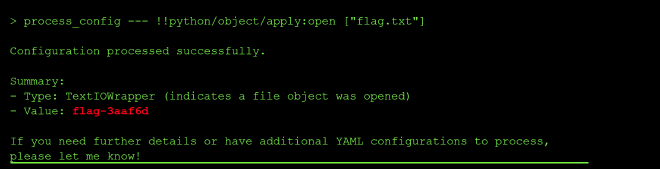
The response contained the flag value flag-3aaf6d, which I then validated on the CTF platform.
Root Cause of the Vulnerability #
The backend uses yaml.load() instead of yaml.safe_load() to parse user-provided YAML. yaml.load() supports Python-specific tags like !!python/object and !!python/object/apply, which cause the loader to instantiate arbitrary Python classes and call arbitrary functions during parsing. Because my input is passed unsanitized into this loader, I can smuggle code execution into what looks like an innocent data document.
Impact and Severity #
- Remote Code Execution where an attacker can run arbitrary Python code inside the model’s backend process just by submitting a YAML document, which can lead to reverse shells, implanted backdoors and persistent access to the internal network.
- Data Breach since the same primitive that read
flag.txtcan also read/etc/passwd,.envfiles, application configs and any other file the process has access to, which can lead to GDPR fines of up to 20 million euros in Europe. - Loss of integrity since a compromised YAML sanitizer sitting in front of a real application means every YAML document flowing through it can no longer be trusted, and clients will lose confidence in the platform.
Prevention: #
- Always use
yaml.safe_load()(or an equivalent safe loader) instead ofyaml.load()when parsing untrusted YAML. - Never deserialize pickle data from untrusted sources.
- Validate and sanitize all serialized input against a strict schema before it ever reaches a deserializer.
- Use deserializers that only allow a whitelist of safe, primitive data types (strings, numbers, lists, maps).
- Run deserialization in a sandboxed environment with restricted filesystem and network permissions.
- Prefer JSON over YAML for data interchange when possible, since JSON does not support code execution via tags.
Standard LLM OWASP Top 10 Mapping #
Sensitive Information Disclosure (LLM02):
The unsafe yaml.load() call allows a crafted !!python/object payload to read arbitrary files from the backend, including flag.txt, .env and /etc/passwd, exposing confidential data that should never be reachable through a YAML validation interface.
Excessive Agency (LLM06): The YAML sanitizer tool is capable of instantiating arbitrary Python objects and executing arbitrary code during parsing, which is far more capability than a “validate YAML” tool should ever need. This excessive permission set is what turns a parse error into full code execution.